English
 Chinese
 Pусский
 Français
 Español
 Deutsch
 Português
 한국인
한국인 عربي
عربي Prev:
null

Jul 04,2026
Pageview: 2
Last summer, a friend’s air conditioner shut down twice in one week. The compressor would hum, the lights would flicker, and then — silence. The local technician blamed “voltage fluctuation” and suggested a stabilizer. But her house already had a voltage protector installed at the main panel. Wasn’t that supposed to fix the problem?
That question isn’t unusual. Walk into any hardware store or scroll through an online catalog, and you’ll see devices labelled “protector” and “stabilizer” sitting side by side, often with overlapping marketing language. The confusion deepens when you discover that some modern units offer adjustable trip thresholds, adding a sense of fine control that used to belong only to stabilizers. It’s tempting to ask: why spend more on a bulky stabilizer if a protector can be dialled in to cover the same ground?
If you’re looking at a more flexible approach to safeguarding sensitive electronics, the real answer lies less in labels and more in what each device actually does to the electricity feeding your equipment. Let’s break it down without the brochure-speak.
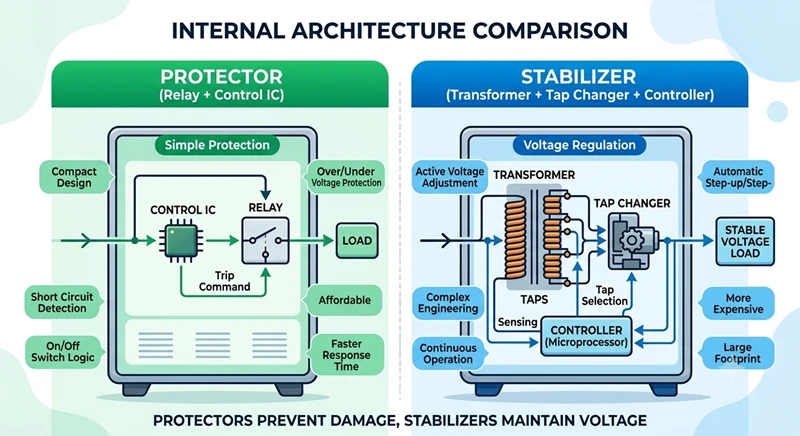
A voltage protector is essentially a vigilant switch. It continuously samples the supply voltage and — if the level falls below a preset low point or climbs above a preset high point — it physically disconnects the load. No reduction, no boosting, no reshaping of the waveform. Think of it as a safety gate: it slams shut when danger is detected, but does nothing to slow down a car that’s already speeding.
A voltage stabilizer, by contrast, is an active conditioner. Older relay-based models tap different transformer windings to raise or lower the output voltage; modern servo and static designs use motorized variacs or IGBT-based converters to maintain a steady voltage band, typically ±1% to ±5%, while absorbing sags and swells in real time. When your utility feed sags from 230 V to 180 V, a stabilizer tries to push it back to usable range without interrupting the circuit.
This explains why the protector didn’t help my friend. Her area suffered prolonged, deep sags on hot afternoons. The protector, spotting voltage far below its safe threshold, did its job: it cut power to prevent damage. But that also meant the air conditioner couldn’t run at all. A stabilizer would have stepped up the voltage enough to keep the compressor spinning — assuming the sag wasn’t so deep that it exceeded the stabilizer’s correction window.
To make the trade-offs concrete, here’s a functional comparison based on typical residential and light‑commercial units.
| Aspect | Voltage Protector (fixed or adjustable trip) | Voltage Stabilizer |
| Core action | Disconnects load outside safe range | Regulates output voltage in real time |
| Response to sag | Cuts power; no output | Boosts voltage; continuous output |
| Response to swell | Cuts power; no output | Bucks voltage; continuous output |
| Typical cut-off time | <0.1 seconds (relay) to micro‑seconds (SSR) | No interruption; regulation lag may be 20–50 ms |
| Power consumption | Negligible (<1 W standby) | 2–5% of connected load (transformer losses) |
| Footprint & weight | Compact, wall‑mountable | Heavier; transformer‑based models bulky |
| Cost (10 A, single‑phase) | $15–$60 | $50–$300+ |
| Best suited for | Loads tolerant to occasional power loss (lights, heaters, pumps with thermal overload) | Voltage‑sensitive equipment (lab instruments, CNC machines, inverter ACs, medical devices) |
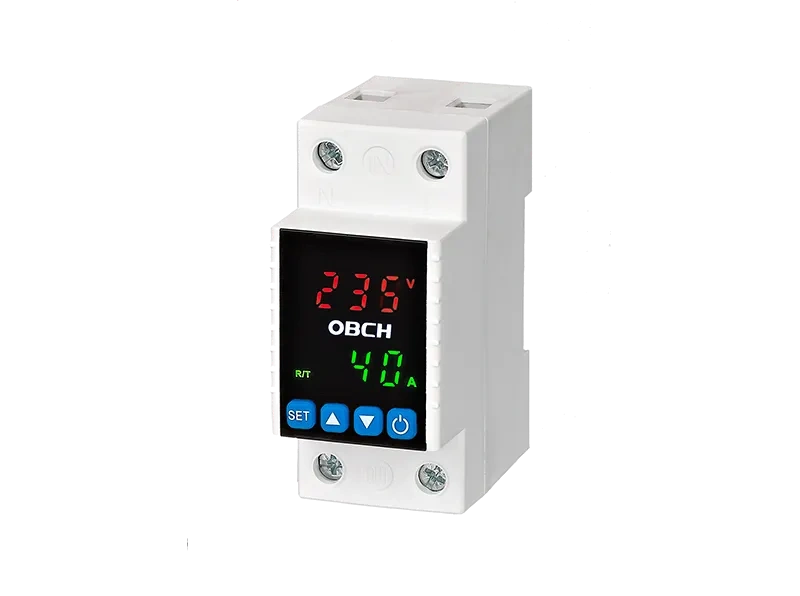
Where the landscape shifts is when protectors move from fixed thresholds to user‑settable limits. A standard protector might disconnect at 170 V and 270 V, while an appliance may actually tolerate 180 V–260 V. That narrow gap can mean hours of unnecessary downtime. By shifting to equipment that lets you define the exact over‑voltage and under‑voltage cut‑off points, you can often eliminate most nuisance tripping while still guarding against genuinely destructive extremes. It doesn’t turn the protector into a stabilizer — there is still no voltage correction — but it makes it far more livable in regions with mild fluctuations.
According to ANSI C84.1, service voltage in the U.S. should stay within ±5% of nominal, and utilization voltage within +4%/−10% at the equipment terminals. Many modern appliances are designed to handle this range without intervention. A refrigerator compressor, for instance, usually has a thermal overload protector and can ride through brief sags without damage. A resistive load like a water heater or incandescent lamp simply runs dimmer or cooler — no harm done.
In these scenarios, a protector that simply removes power when things go wildly out of spec is often enough. And if the device can be tuned so that the low‑cut is set at, say, 190 V instead of a factory‑fixed 170 V, you won’t lose refrigeration just because the grid drooped below a conservative factory default. This is where the newer breed of user‑configurable protection gear really shines — it matches the safeguard to the actual tolerance of the load, not a one‑size‑fits‑all assumption.
However, for equipment that must not stop or that draws a destructive inrush when power is restored too quickly, even the best protector is inadequate. A submersible pump with a long vertical riser, an MRI coldhead, or a semiconductor fab’s lithography tool cannot afford a restart cycle every time voltage wobbles. Here, a stabilizer — often with a protector upstream as a secondary failsafe — remains non‑negotiable.
Adjustable voltage protectors enter the conversation as a pragmatic middle layer. They let you widen or tighten the acceptance window based on actual measurements at the outlet. For a home server rack, you might set a tight 210 V–250 V window to avoid brownout‑induced PSU stress. For a garage compressor, a looser 190 V–260 V window might prevent false trips during motor start‑up, while still disconnecting if the supply rises dangerously high after a phase imbalance.
But here’s the critical nuance: no adjustment can replace missing voltage. If your mains voltage routinely sits at 180 V for an hour, adjusting the low‑cut to 170 V doesn’t make the compressor run properly — it just stops the protector from disconnecting while the appliance struggles, overheats, or refuses to start. That’s the boundary line. An adjustable protector can make the protection smarter, but it cannot make the voltage healthier.
When you come across a spec sheet for these adjustable safeguarding devices, look closely at whether the unit offers any buck/boost functionality. Some hybrid products do exist that combine relay‑based voltage trimming with adjustable disconnect thresholds, but they are still a minority. Most “adjustable” units are just protectors with a user‑set window and maybe a restart delay timer — which, to be fair, already solves a huge chunk of field complaints.
Use this straightforward decision path:
Measure first. Log your supply voltage over at least 24–48 hours with a min/max recorder. If you never see sags below 200 V or swells above 250 V on a 230 V nominal system, your grid is reasonably stable.
List your critical loads. Mark any device that cannot tolerate an unexpected shutdown (medical CPAP, security DVR, freezer with expensive contents). Those may need a stabilizer or a UPS, not just a protector.
Check the equipment’s tolerance. The manual or nameplate often states an acceptable voltage range. If your recorded extremes fall within that band, a well‑set protector is probably all you need.
If you opt for a protector, choose an adjustable model. The few extra dollars pay for themselves the first time you avoid an unnecessary midnight outage because the factory default was too conservative.
For worst‑case protection, combine both. A stabilizer handles the daily wobble, and an upstream protector with a wide set of limits acts as a backstop if the stabilizer saturates or the line voltage exceeds the stabilizer’s operating range.
A voltage protector cannot truly replace a voltage stabilizer any more than a circuit breaker can replace a generator. One is a safety disconnect; the other is an active power conditioner. The market’s shift toward adjustable protection thresholds has blurred the practical line in moderate environments, but the foundational physics remains unchanged. When you need voltage corrected, only a stabilizer (or an online UPS) will do. When you primarily need voltage gaps closed before they cause damage, an intelligent, adjustable protector delivers a lot of value in a small, cost‑effective package.
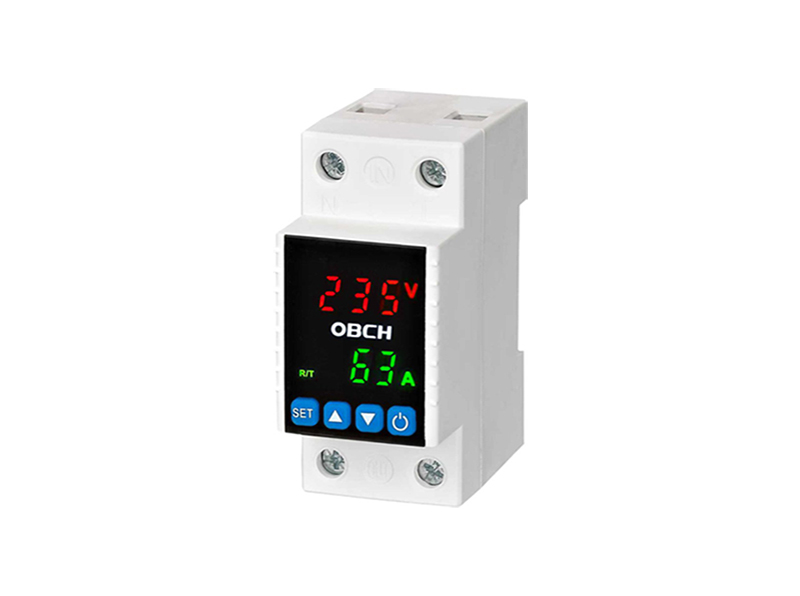
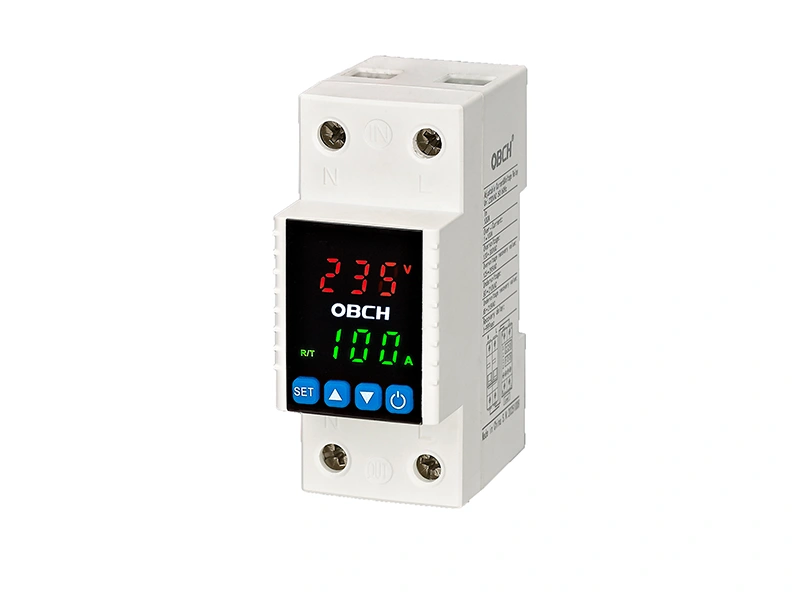
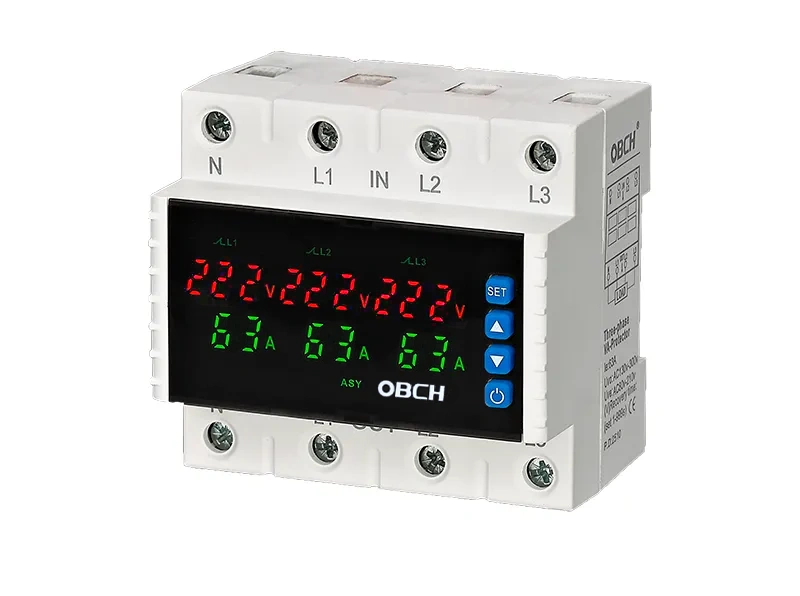
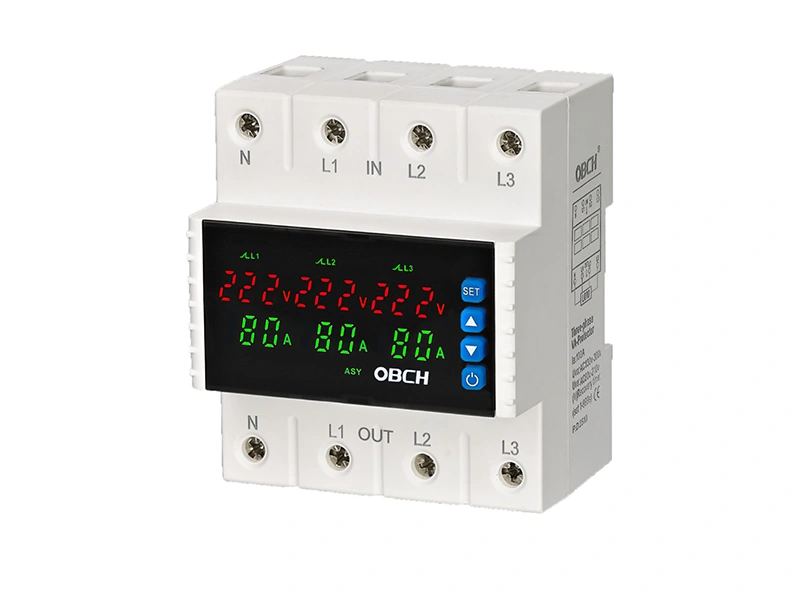
If you’re trying to build a reliable protection strategy without over‑engineering every circuit, it helps to have gear that makes those threshold decisions clear and reproducible. For a closer look at what a purpose‑built, configurable protective device can cover in a residential or light commercial setting, explore Obch’s range of voltage and current protection equipment. Whichever route you choose, grounding your decision in actual power quality data — not fears or marketing tags — will always be the most dependable path.